Where to Start Building a Direct Booking Channel, it Depends on Where You Are Now
There is no universal starting point. There is the right one for your operation.

Isabel Azevedo
27 Mar 2026
•5 min read


Introduction
If you have landed on this article, you probably already have a sense of what is holding your direct bookings back. The diagnosis tends to be straightforward, most operators recognise their situation the moment they see it described clearly.
What is far less obvious is where to begin fixing it.
The instinct is usually to tackle everything at once: new website, Google Ads, SEO, reviews, booking system. The result is almost always the same, a project that drags on for months, spreads budget across too many fronts, and delivers no clear results on any of them because nothing was ever properly finished.
Order matters. And the right order is not the same for everyone. It depends on what is costing you the most revenue right now, not on what looks most impressive or feels easiest to start.
Across our work with tourism operators in Portugal, two distinct starting points come up again and again. The sequence that makes sense is different for each one.
Starting point A — You are launching, or you have no structured direct channel
You operate through word of mouth, WhatsApp, or exclusively through OTAs. You have a product, you have customers, but you have no digital infrastructure of your own. Every booking that comes through a third-party platform is a commission that leaves, and a customer whose data will never belong to your business.
In this case, the sequence that makes most sense is to build from the inside out: engine first, visibility second, performance third.
1. An autonomous booking system
This is the first step because without it, nothing else converts. You can have the best website in the world, the most well-configured Google Ads campaign, and the most optimised Google Business Profile (GBP), but if a customer arrives ready to book and finds a contact form or a WhatsApp button, the intention dies right there.
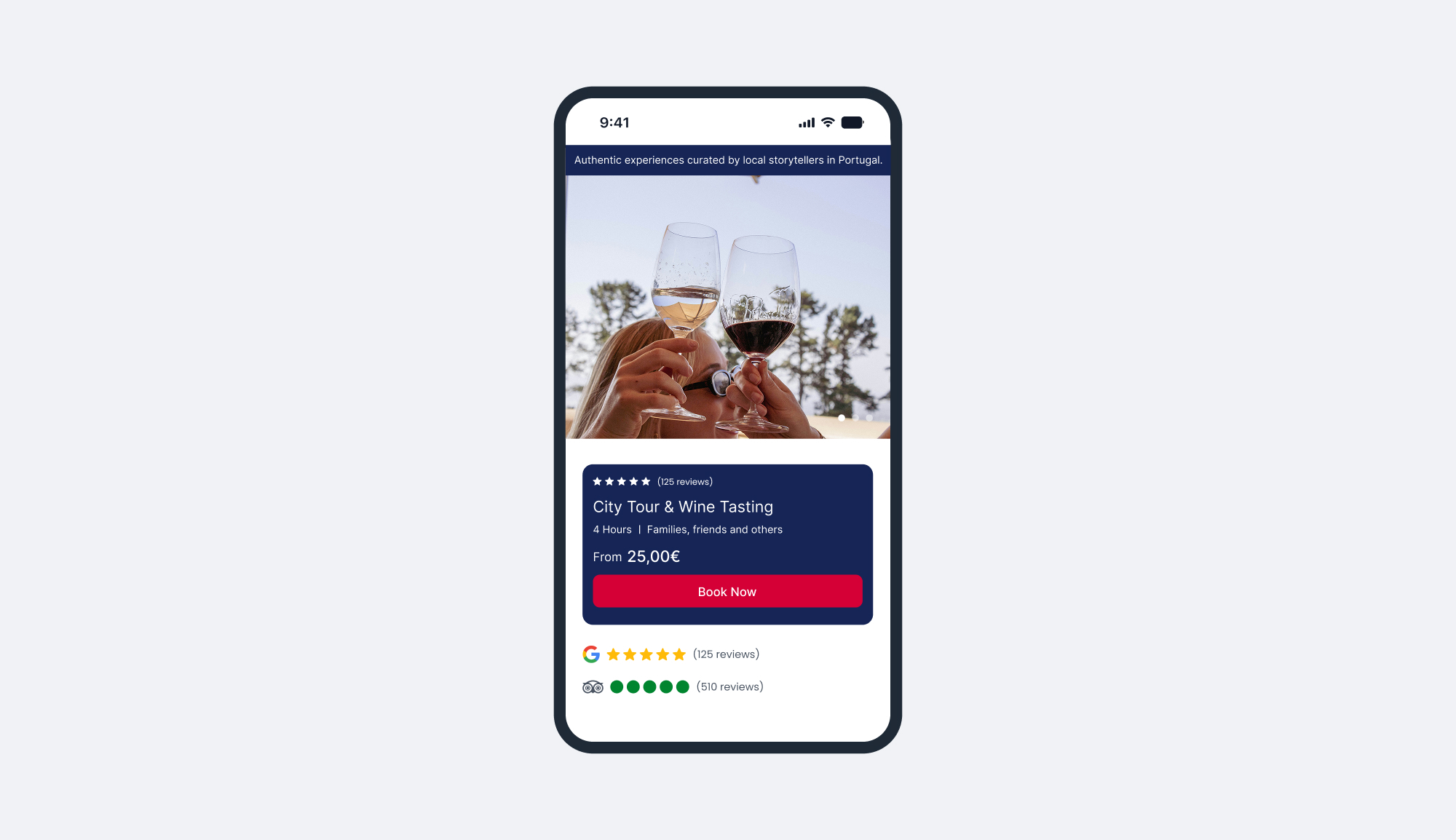
The booking system is the engine of your digital operation. It needs to let customers check real-time availability, select a date and number of participants, pay, and receive automatic confirmation, with no manual intervention required. For tour and activity operators, there are various solutions on the market at different levels of complexity and cost. The right choice depends on your volume, product type, and how much integration you need with other channels like OTAs.
2. A website built around your experiences
Not a generic homepage with a company description. Specific pages per product, with a clear title, detailed description, real photos, visible pricing, duration, meeting point, cancellation policy, and a booking button integrated with your system.
This is where all the traffic you are about to generate needs to land, and it needs to be ready to convert when it gets there. A website without these well-structured pages is not working for your business. It is simply existing.
3. An optimised Google Business Profile
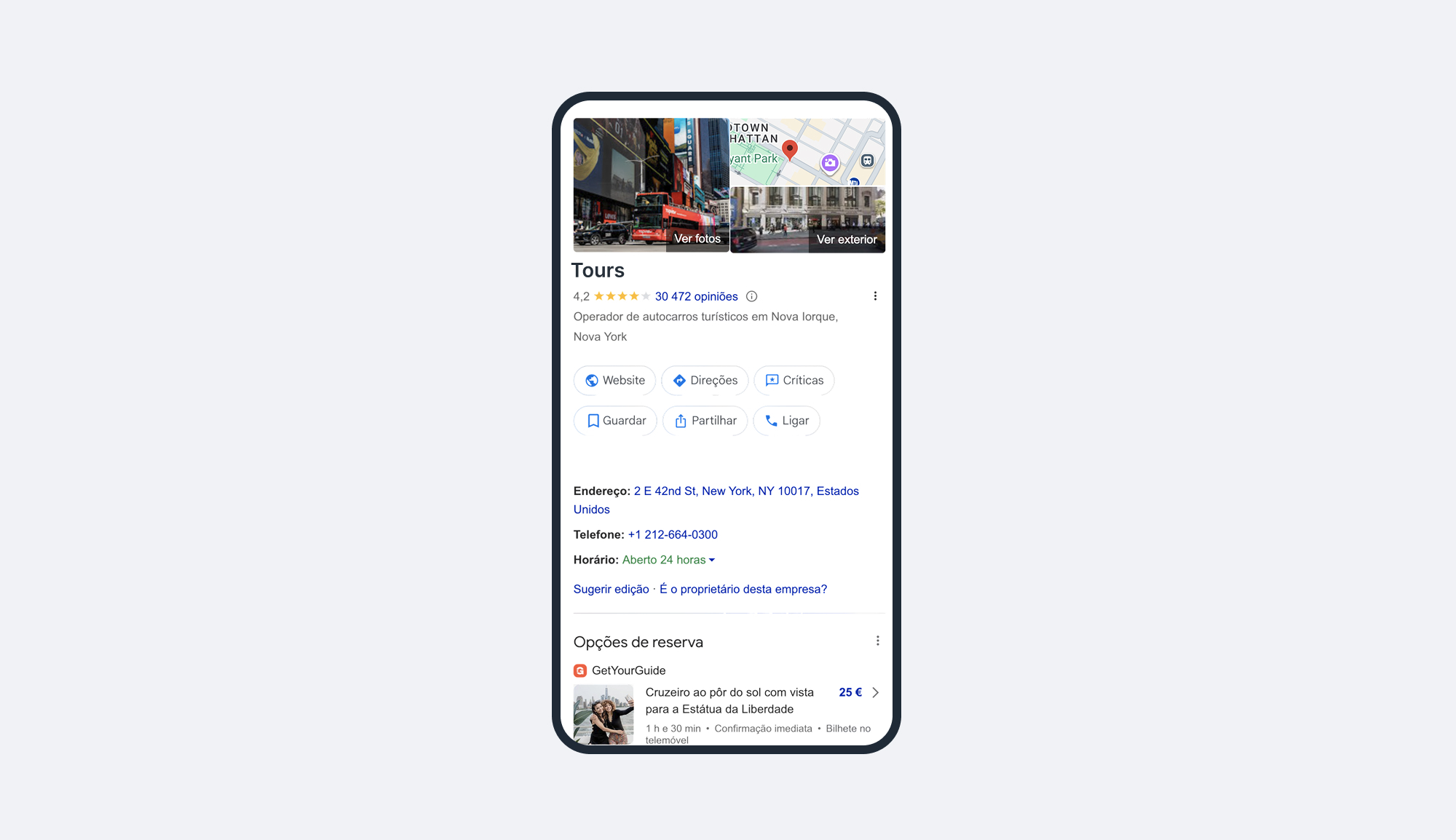
When someone searches "tours in Lisbon" or "things to do in the Douro Valley", Google surfaces a list of businesses before any organic result or paid ad. This is where many operators simply do not appear, or appear with an incomplete profile that does not inspire confidence.
A well-configured profile includes up-to-date photos of your experiences, correct categories, opening hours, a direct link to your booking page, and responses to existing reviews. For operators with a booking system integrated with Google Things To Do, the GBP can become a direct sales channel, with experiences appearing in Google results with a Book Now button, at zero OTA commission.
4. Google Ads with reservation tracking
With the website and booking system in place, Google Ads is the fastest way to generate your first direct bookings. It puts your business on page one the very day the campaign goes live, without waiting the three to six months that SEO needs to produce consistent organic results.
But there is one condition: tracking must be configured to measure confirmed bookings, not clicks or website visits. Without that data, it is impossible to know whether the investment is working. With it, after thirty days you have a real cost-per-booking figure for your specific business, and every decision about how much to invest becomes evidence-based, not a guess.
5. Automating your review requests
Once bookings start coming in, you have a growing base of customers who have been through the experience. This is the moment to activate an automated request, an email or SMS sent twenty-four to forty-eight hours after the experience, with a direct link to your review page.
In tourism, reviews are the primary decision filter for a first-time customer. An operator with eight reviews and one with a hundred and twenty may deliver exactly the same quality, but the second will convert far more visitors who have never heard of the brand. The difference is rarely the experience. It is the system.
6. SEO running in parallel from day one
SEO does not replace Ads, it is the layer that grows while Ads do the immediate work. Optimised content, solid technical structure, and domain authority build over time. The earlier you start, the stronger the long-term competitive advantage. Twelve months in, an operator who started SEO on launch day has qualified organic traffic that progressively reduces dependence on paid media.
Starting point B — You already have a digital presence, but it is not delivering
You have a website, possibly Google Ads, possibly a GBP. Direct bookings exist but are not growing the way they should. OTAs remain the primary channel, not by strategic choice, but by default. The direct channel exists but is not doing its job.
Here the task is not to build from scratch, it is to find where the leakage is and fix that first. These four questions help locate the problem.
Question 1: Does your Google Ads campaign know what a booking is?
If your campaign's conversion event is a website visit, a button click, or a scroll to the bottom of the page, Google's algorithm is optimising for the wrong goal. It is finding people who click, not people who book.
Reconfiguring the tracking to fire on confirmed booking is often the single change with the greatest immediate impact on campaigns that appear to be working but are not generating measurable return. It can be done in hours. And the data it unlocks changes everything about how you manage your marketing spend.
Question 2: Is your GBP sending traffic to your website or to an OTA?
A well-ranked GBP with hundreds of reviews is a valuable asset. But if the booking button on your profile sends users to GetYourGuide or Viator instead of your own website, that asset is working against you.
Checking where each action button on your profile actually points is the first step. The second is making sure the booking link goes to your own system, not to a platform that will charge commission on a customer who already knew your brand and was actively looking for you.
Question 3: Is there invisible friction in your booking flow?
A customer who starts a booking and drops off does not send you an email to explain why. They simply disappear. And that loss does not show up in any report, it only becomes visible when Google Analytics 4 is properly configured with booking funnel events.
Going through your own booking process as a first-time customer, on a mobile, in a browser with no history, with no prior knowledge of the system, regularly reveals obstacles that are completely invisible from the inside. An extra step in the process, a slow-loading page, or a cancellation policy that is not visible before payment are each enough to lose a booking.
Question 4: Are you requesting reviews systematically?
If the honest answer is "rarely" or "when I remember", your digital reputation does not reflect the actual quality of your service. In a market where first-time customers make decisions based on what others say, a stagnant review count is a growing competitive disadvantage.
The solution is not to ask more often manually, it is to automate. A system that sends the request at the right moment, through the right channel, with a direct link to your review page, turns every completed experience into a systematic opportunity to build reputation, with no additional effort from your team.
The principle that always applies
Regardless of where you are starting from, one rule applies to every operation:
Fix what is costing you money today first — not what looks most impressive.
An operator without booking tracking in Google Ads is spending money without knowing if it is working. A GBP that sends traffic to GetYourGuide or Viator is funding the competition with customers who already knew the brand. A website without a booking system is losing customers every night, at eleven pm on a Friday, when there is no one to reply to a WhatsApp message.
These are not complex problems. They are infrastructure problems with known solutions. The difficulty is not knowing what to do, it is having the right team to implement everything in an integrated way, at the right time, without each piece depending on another that is not yet ready.
Not sure where you stand?
Most operators who contact us know something is not working, but are not sure what the main problem is or where to begin. Sometimes it is the tracking. Sometimes it is the GBP. Sometimes it is a booking system that exists but is not integrated with the website. Sometimes it is everything at once, and the question is which to fix first for the fastest impact.
Before any proposal, we analyse the current operation: sales channels, booking system, digital presence, active campaigns. Then we deliver everything, integrated, in ninety days.
See other stories

The Power of Niche: Guide to the Best OTAs for Wine Tourism, Adventure, and Gastronomy in 2026
If you are a tour operator in Portugal and your distribution strategy begins and ends with Viator and GetYourGuide, we have a positioning problem.

The Real Cost of Running a Tourism Operation in Excel
When spreadsheets stop being a tool and become a structural cost.
Excel helps tourism businesses get started. But as operations grow, manual processes quietly become a hidden cost that limits scale, margin, and operational control.
The Real Decision Behind Google Ads and OTAs
It’s not about choosing a channel, it’s about protecting margin, control, and long-term brand value.
In tourism, the right investment depends on your operation, your seasonality, and how much control you want to keep over demand that already exists.



